
Trade Dollars: The Only US Coin the Government Disowned
A Silver Dollar Built to Win an Argument in China
In 1873 the United States struck a silver dollar that was never really meant to circulate at home.
Mexican silver — the 8 reales, and later the peso — dominated trade across East Asia. Chinese merchants trusted it, weighed it, and priced against it. American traders arriving with United States silver dollars found their money discounted or refused outright. So the Coinage Act of 1873 authorized a purpose-built export coin, engineered to beat the Mexican peso on the only measure that mattered: silver content.
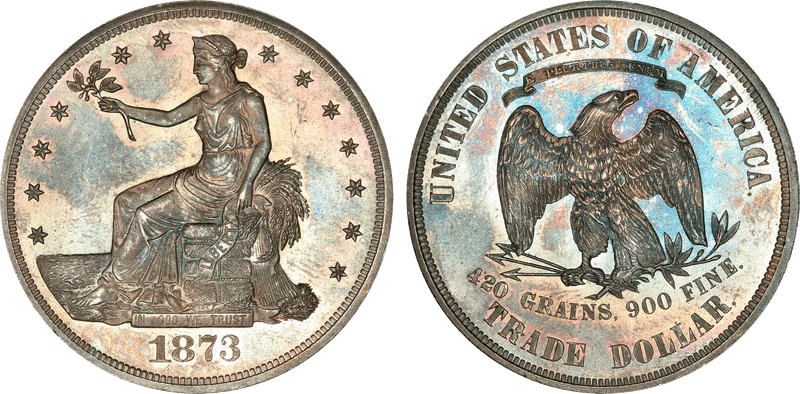
The Trade dollar carried 420 grains — 27.22 grams — of .900 fine silver. That is more silver than the Morgan dollar that followed it, and the coin says so out loud: the reverse is inscribed 420 GRAINS, 900 FINE, a specification stamped directly onto the coin so that any merchant could verify what they were holding.
William Barber's obverse shows Liberty seated on a bale of merchandise, facing west across the Pacific, extending an olive branch toward Asia. Few American coins state their purpose this plainly.
And it worked. Trade dollars circulated widely in China, struck for circulation from 1873 to 1878 at Philadelphia, San Francisco and Carson City, with production concentrated at San Francisco near the Pacific trade routes.
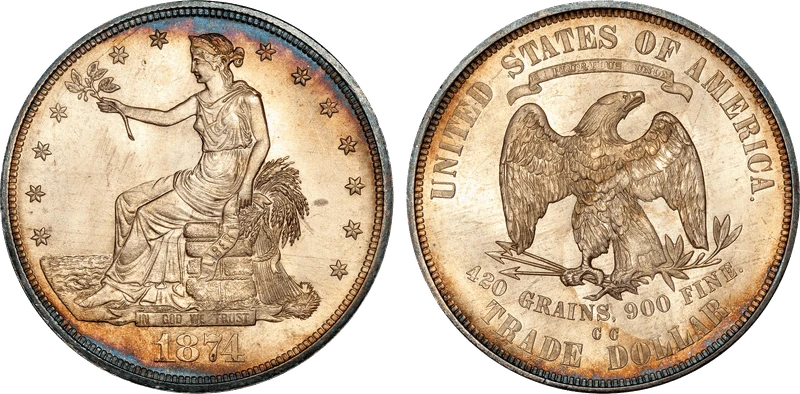
An 1874-CC — Carson City struck Trade dollars from 1873 through 1878, and the CC mint mark carries its own following among collectors.
Then the Government Turned On It
Silver prices fell through the mid-1870s. A coin containing 420 grains of silver was suddenly worth less as metal than its face value implied, and Trade dollars began flowing back into the United States rather than out of it.
Congress responded with the Coinage Act of 1876, which stripped the Trade dollar of its domestic legal tender status — while the Mint was still striking it.
The coin still said UNITED STATES OF AMERICA. It still carried 420 grains of silver. It simply was not money at home any more.
The millions already in circulation did not disappear. They traded at a discount — sometimes eighty or ninety cents on the dollar. Employers bought them cheaply and paid workers in them at face value, and workers who were not in a position to refuse their wages absorbed the difference. It is one of the harder chapters in American monetary history, and it followed directly from a policy decision rather than from anything wrong with the coin.
Production for circulation ended in 1878. Proof-only striking continued quietly through 1885.
The Rarities at the End
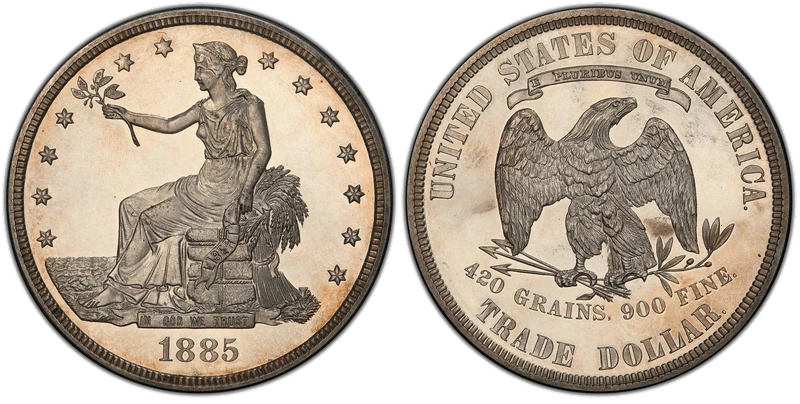
The proof-only years produced two of the great American rarities. The 1884 Trade dollar has approximately ten known examples. The 1885, pictured above, has approximately five.
Neither was publicly announced at the time. Both surfaced later, and their legitimacy was argued over for years afterward. A five-known coin from a denomination the government had already disowned is about as good as a numismatic story gets.
The Crime of '73 — and Where the Morgan Dollar Came From
The Coinage Act of 1873 did two things at once. It created the Trade dollar, and it ended free coinage of silver — effectively demonetizing silver for domestic money.
Silver interests called it the "Crime of '73." The backlash was enormous, and it produced the Bland-Allison Act of 1878, which forced the Treasury to buy silver and strike it into standard silver dollars.
That act created the Morgan dollar.
So the same law produced both coins. The Trade dollar and the Morgan are two outcomes of a single fight over what silver was for, four years apart. If you want the other half of that story — and the die-variety system built around the coin the backlash created — see VAM Collecting: The Morgan Dollar Deep Dive.
What Is in the Catalog
NumisDex catalogues the complete Trade dollar series: all 13 dates from 1873 through 1885, every mint that struck them (Philadelphia, San Francisco and Carson City), and every proof-only year — including the 1884 and the 1885.
Behind it sits a second collection: 378 listings from the Trade Dollar Era Patterns (1871-1873), the experimental designs from the years when the Mint was still working out what a commercial dollar ought to look like.
- Browse the complete Trade Dollar series
- Browse the Trade Dollar Era Patterns (1871-1873)
Discussion
- Do you have a Trade dollar in your collection — type example, or are you working the date set?
- Chopmarked or clean? Chopmarks are physical evidence the coin did the job it was made for, but they are still damage. Which side are you on?
- Carson City Trade dollars sit in the shadow of CC Morgans. Underrated?
- Does a coin the government stripped of legal tender status belong in a US type set?
Related Reading
- The Dollar Coin: Eleven Designs, 232 Years — the full denomination overview this series sits inside
- VAM Collecting: The Morgan Dollar Deep Dive — the coin the Crime of '73 backlash produced
- Morgan Dollars: Why America's Most Collected Coin Still Captivates
0 Replies
Related Threads
- The Dollar Coin: Eleven Designs, 232 Years, and a Country That Still Won’t Use Them0 replies · 1mo ago
- 2027 American Innovation Dollars: CCAC Selects Designs for Oregon, Kansas, West Virginia, and Nevada0 replies · 3mo ago
- 2026 American Innovation Dollars: Iowa, Wisconsin, California, and Minnesota0 replies · 3mo ago
- The $10 Million Dollar: When Did Your Dollar Series Begin?0 replies · 4mo ago
- Morgan Dollars: Why America's Most Collected Coin Still Captivates0 replies · 4mo ago