
The Dollar Coin: Eleven Designs, 232 Years, and a Country That Still Won’t Use Them
The Denomination America Keeps Making and Keeps Ignoring
The United States has been striking dollar coins since 1794. In that time, the denomination has been redesigned eleven times — more than any other coin in American history. And for the last 90 years, Americans have consistently refused to carry one.
The Morgan dollar was the last dollar coin that genuinely circulated in American commerce. Everything since — Eisenhower, Susan B. Anthony, Sacagawea, Presidential, American Innovation — went straight from the Mint to collectors, vending machines, or Federal Reserve vaults. The dollar coin’s story is a 232-year cycle of redesign, relaunch, and rejection.
But before the rejection came the reign. For the first century of American coinage, the dollar was a cornerstone denomination — the backbone of international trade and the standard measure of value in domestic commerce. Understanding the dollar coin means understanding how American money evolved from hand-struck silver to mass-produced golden tokens that nobody wants to spend.
Eleven Designs Across 232 Years
Flowing Hair (1794–1795)
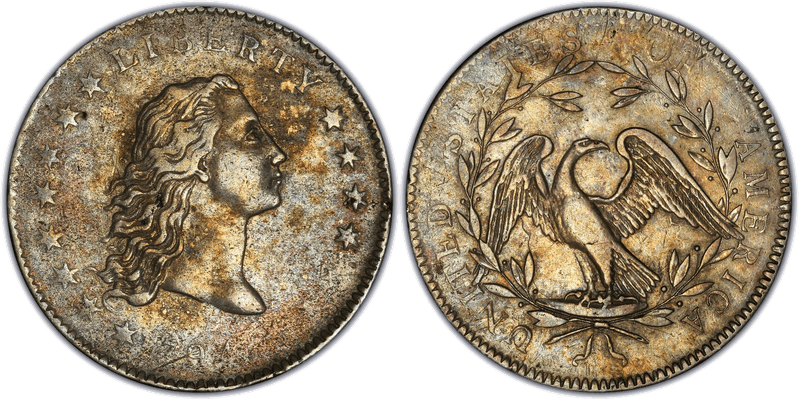
The first silver dollar struck by the United States Mint. Robert Scot’s design features Liberty with flowing, unbound hair on the obverse and a small eagle within a wreath on the reverse. Only 1,758 were struck in the first year of production, and the 1794 Flowing Hair Dollar holds the record for the most expensive coin ever sold at auction — over $10 million.
These coins were struck on hand-operated screw presses at the Philadelphia Mint, and the equipment was barely adequate for the task. The silver planchets were rolled to thickness by hand, cut individually, and struck one at a time. Many surviving examples show adjustment marks (file marks applied to reduce overweight planchets to the correct weight) and weak strikes at the centers where the press couldn’t deliver enough force.
The Flowing Hair dollar was the first American coin to carry the denomination’s full weight in silver — 26.96 grams of .8924 fine silver, establishing the dollar as a coin of substance and international credibility.
Draped Bust (1795–1804)
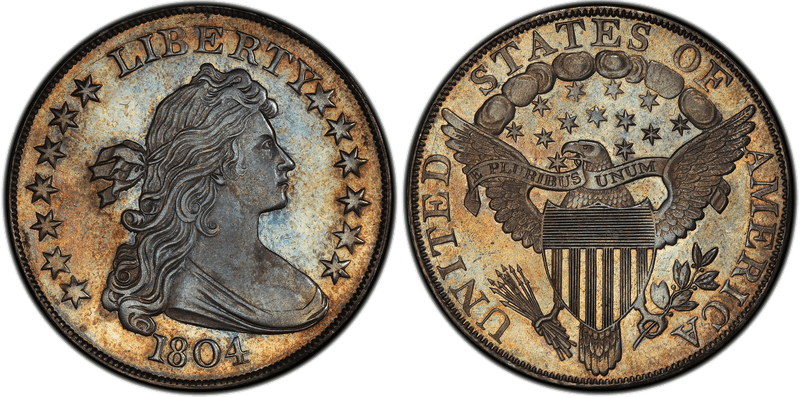
Gilbert Stuart’s idealized portrait of Liberty with a draped bust, believed to have been modeled after Philadelphia socialite Ann Willing Bingham. Two reverse subtypes: the Small Eagle reverse (1795–1798) and the Heraldic Eagle reverse (1798–1804).
The 1804 dollar is the “King of American Coins” — and one of the great mysteries in numismatics. Despite bearing the date 1804, none of the known specimens were actually struck in 1804. The Mint produced no silver dollars from 1804 through 1835. The coins dated 1804 were struck in the 1830s and 1850s as diplomatic presentation pieces, backdated to 1804 because that was the last date on record for dollar production. Fifteen examples are known across three classes (Original, Restrike, and Irregular), and each is worth millions.
The real question is why the Mint stopped making dollars in 1804. The answer: silver dollars were being exported in bulk. American silver dollars contained slightly more silver than their Spanish colonial equivalents, so merchants and speculators shipped them overseas for melting and recoining at a profit. President Jefferson ordered dollar production suspended because the coins were leaving the country as fast as the Mint could make them.
Seated Liberty (1836–1873)
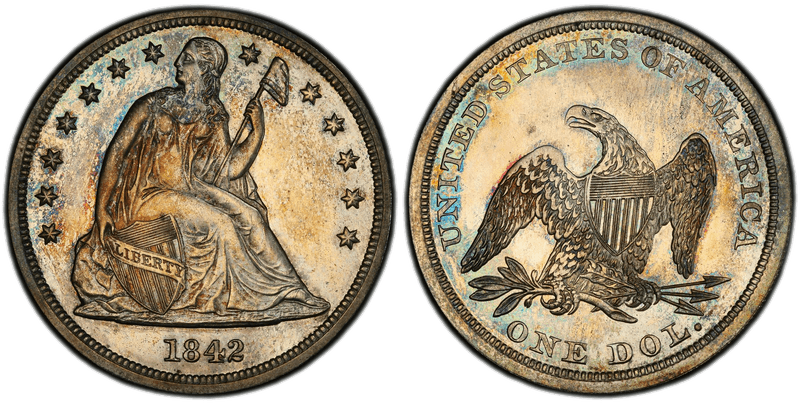
After a 31-year gap with no dollar production, the denomination returned with Christian Gobrecht’s Seated Liberty design. Liberty sits on a rock, holding a pole topped with a Phrygian cap (the ancient symbol of freedom) and a shield inscribed “LIBERTY.” The reverse features a bald eagle with spread wings.
The Seated Liberty dollar ran for 37 years and saw several modifications: the addition of “IN GOD WE TRUST” on the reverse in 1866 (prompted by the religious sentiment of the Civil War era), and arrows at the date in 1873 (indicating a minor weight adjustment). This series spans some of the most turbulent decades in American history — the Mexican-American War, the California Gold Rush, the Civil War, and Reconstruction.
Key dates include the 1851 and 1852 (low mintages because silver was flowing to private mints during the Gold Rush), and the entire run of Carson City issues (1870–CC through 1873–CC), which are collected for their Western frontier provenance.
Trade Dollar (1873–1885)
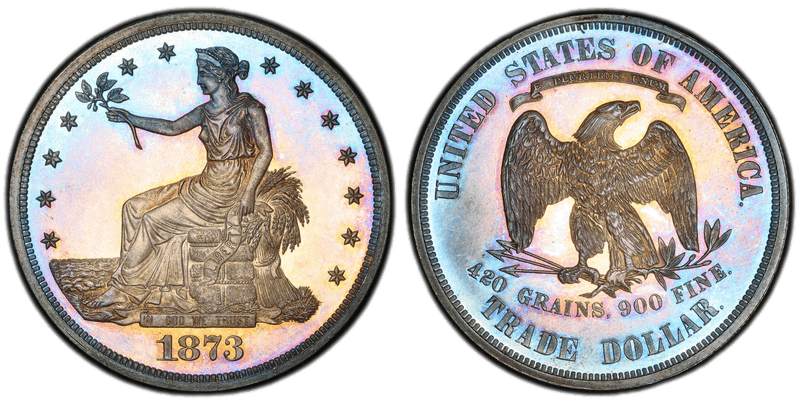
The Trade Dollar is unique in American coinage: it was designed not for domestic use, but specifically for trade with China and Japan. At 420 grains (27.22 grams), it was intentionally heavier than the standard silver dollar (412.5 grains) to compete with the Mexican peso in Asian markets. William Barber’s obverse shows Liberty seated, facing left, extending an olive branch toward Asia. The reverse features an eagle with spread wings above sheaves of wheat and cotton.
The Trade Dollar holds the dubious distinction of being the only U.S. coin ever officially demonetized. In 1876, Congress revoked its legal tender status for domestic transactions (it had originally been legal tender up to $5). This meant that employers could — and did — pay workers in Trade Dollars that were worth less than their face value in everyday commerce. The coin became a symbol of labor exploitation until Congress finally reauthorized its redemption in 1887.
The 1884 and 1885 Trade Dollars were struck exclusively as proofs in extremely small quantities (10 and 5 pieces, respectively) and are among the rarest of all U.S. coins.
Morgan (1878–1921)
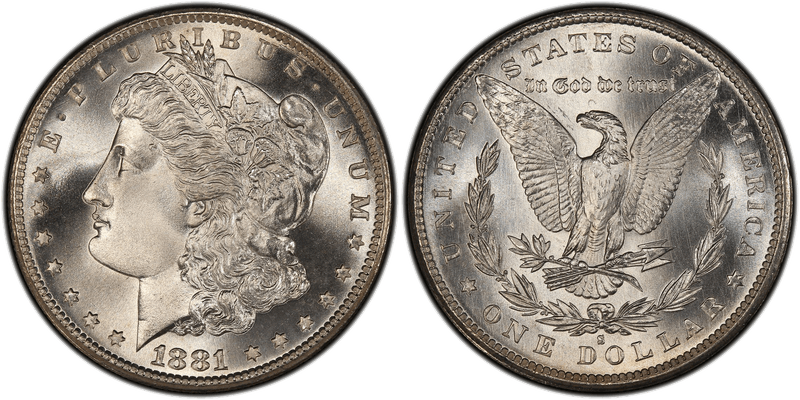
George T. Morgan’s design is the iconic American silver dollar. Liberty faces left, hair bound in a Phrygian cap wreathed with cotton and grain, surrounded by stars. The reverse features a heraldic eagle with spread wings, clutching arrows and an olive branch.
The Morgan dollar exists because of politics, not commerce. The Bland-Allison Act of 1878 required the U.S. Treasury to purchase millions of dollars’ worth of silver each month from Western mining interests and coin it into dollars. The result: over 650 million Morgan dollars were struck between 1878 and 1921, most of which went straight into Treasury vaults in canvas bags, where many sat untouched for decades.
The massive Treasury releases of the 1960s — when bags of uncirculated Morgan dollars were sold at face value from government vaults — created one of the most popular collecting series in numismatics. The combination of large size, beautiful design, silver content, and ready availability makes the Morgan dollar the entry point for millions of collectors.
Key dates: 1893–S (mintage of 100,000 — the key to the series), 1889–CC (Carson City rarity), 1895 Proof (no business strikes known, the “King of Morgan Dollars”).
Peace (1921–1935, 2021)
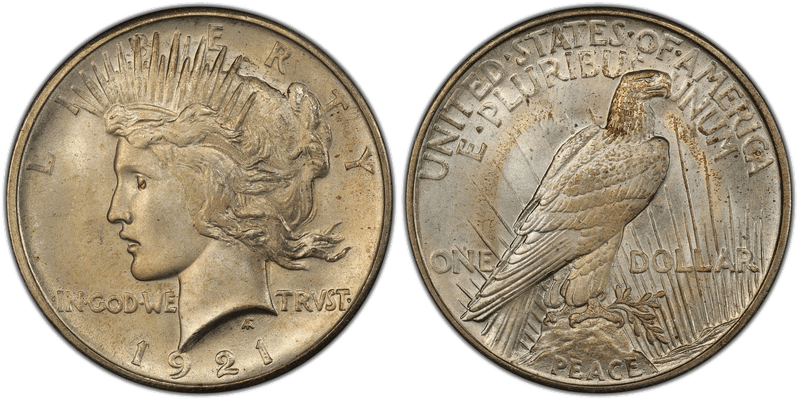
Anthony de Francisci’s design was created to commemorate the end of World War I. Liberty faces left, wearing a radiate crown. The reverse shows a bald eagle perched on a rock above the word “PEACE.” The 1921 High Relief issue (shown above) was the first year of production and features a dramatically sculpted design that was flattened in subsequent years because the high relief caused production difficulties.
The Peace dollar was the last circulating silver dollar. Production ended in 1935, and the denomination wouldn’t return for 36 years — and when it did, it would never be silver again. A special 2021 issue was struck to mark the centennial of the original design.
An interesting historical footnote: 316,076 Peace dollars were struck with a 1964 date at the Denver Mint, but all were ordered melted before release. None are known to have survived (though rumors persist). Had they been released, they would have been the last 90% silver dollars struck for circulation.
Eisenhower (1971–1978)
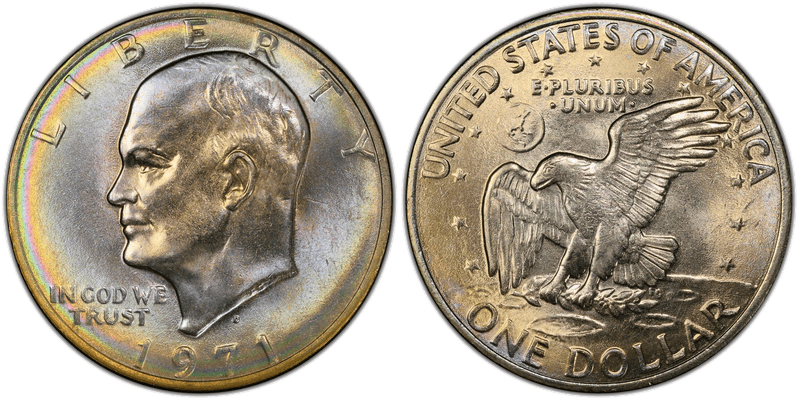
The dollar coin returned after a 35-year absence, now in copper-nickel clad (no silver content in the business strikes). Frank Gasparro designed both sides: President Eisenhower on the obverse and the Apollo 11 mission insignia — an eagle landing on the Moon — on the reverse. The design honored both the former president and general and the 1969 Moon landing.
The Eisenhower dollar was the last large-size dollar coin. At 38.1mm diameter and 22.68 grams, it was massive — too big for pockets, too heavy for purses, and too similar to a half dollar in size to be practical for commerce. Most Ike dollars ended up in casino slot machines, which were the primary commercial use for the denomination.
Special collector editions (1971–S, 1972–S, 1973–S, 1974–S) were struck in 40% silver for sale to collectors. The Bicentennial reverse (1776–1976 dual date) featuring the Liberty Bell superimposed on the Moon was designed by Dennis R. Williams.
Susan B. Anthony (1979–1981, 1999)
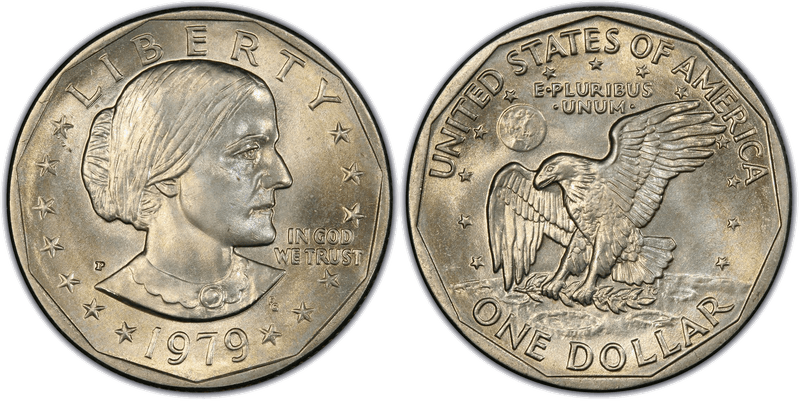
The Mint’s answer to the Eisenhower dollar’s size problem: make it smaller. Much smaller. Frank Gasparro’s portrait of suffragist Susan B. Anthony on the obverse, with a miniaturized version of the Apollo 11 eagle on the reverse. The Susan B. Anthony dollar was the first U.S. coin to honor a real, named woman.
It was also a disaster. At 26.5mm diameter, the SBA dollar was nearly identical in size and color to a quarter (24.3mm). Americans couldn’t tell them apart by touch in a pocket or purse, and vending machine confusion was rampant. The public rejected the coin so thoroughly that production was suspended after just three years (1979–1981). A one-year revival in 1999 was struck only because existing inventories of SBA dollars had been depleted by the transit and vending industries.
The SBA dollar proved that size matters — but color matters more. The Mint learned that lesson for the next attempt.
Sacagawea / Native American (2000–present)
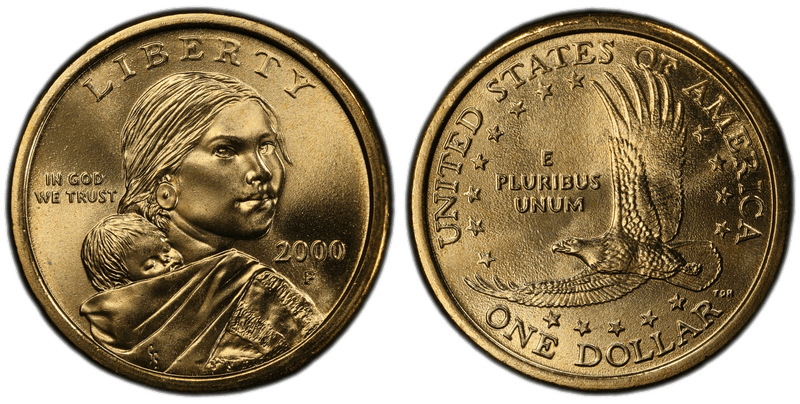
The Mint’s response to the SBA debacle: a golden-colored dollar that nobody could confuse with a quarter. Glenna Goodacre’s portrait of Sacagawea with her infant son Jean Baptiste on the obverse, Thomas D. Rogers’s soaring eagle on the original reverse. The manganese-brass composition (88.5% copper, 6% zinc, 3.5% manganese, 2% nickel) gives the coin a distinctive golden color and a smooth, plain edge.
The Sacagawea dollar solved the quarter-confusion problem completely. Americans could instantly distinguish it by color and feel. But the coin still failed to circulate — because the real problem was never confusion with the quarter. The real problem was the dollar bill. As long as Americans could use a lightweight paper dollar, they had no incentive to carry a heavier metal one.
Beginning in 2009, the reverse design changed annually under the Native American Dollar program, honoring different contributions of Native Americans and tribal nations. The obverse Sacagawea portrait remains unchanged.
Presidential (2007–2016)
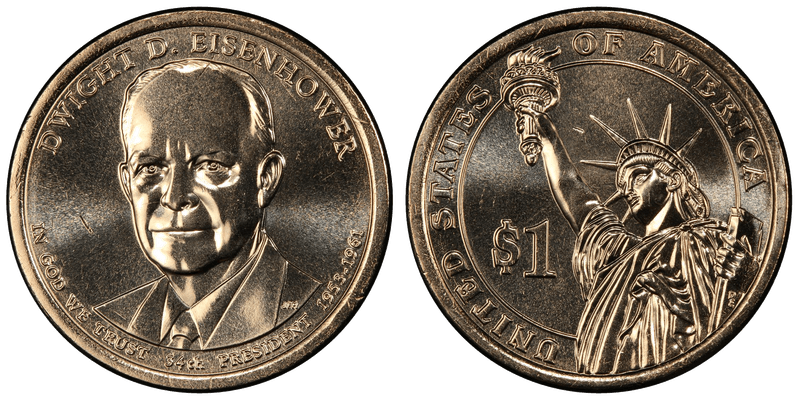
Four presidents per year, in chronological order, beginning with George Washington in 2007. The Presidential dollar program put each president’s portrait on the obverse, with the Statue of Liberty on the reverse. Edge lettering (rather than face lettering) carried the date, mint mark, and “E PLURIBUS UNUM.”
The program produced some of the most notable modern errors: “godless dollars” where the edge lettering (including “IN GOD WE TRUST”) was missing, struck on blank edges. These errors generated media attention but didn’t generate public enthusiasm for actually using the coins. Congress ended the program after honoring Ronald Reagan in 2016, halting at presidents who had been deceased for at least two years.
In 2011, a government audit found that the Federal Reserve had over $1.4 billion in unwanted dollar coins sitting in vaults — a direct result of a Congressional mandate to keep minting coins that the public wouldn’t use. Production for circulation was suspended, and Presidential dollars were minted only for collectors from 2012 onward.
American Innovation (2018–present)
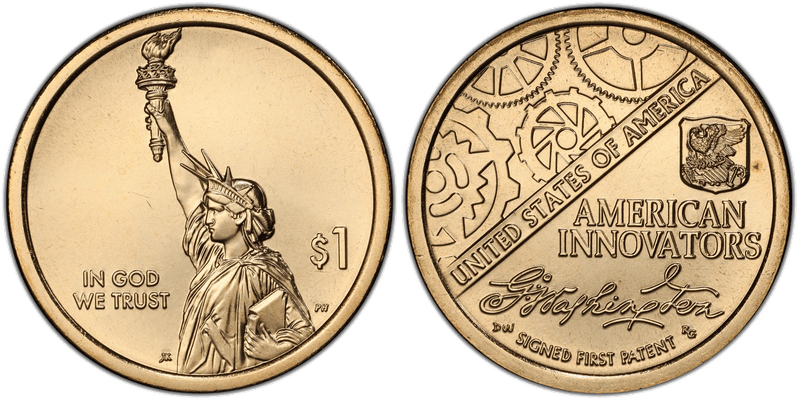
The current dollar coin program: four designs per year, each honoring a significant innovation or innovator from a different state or territory. The obverse features a common design of the Statue of Liberty, while the reverse changes quarterly. The 2018 introductory coin (shown above) depicts George Washington’s signature on the first U.S. patent.
The American Innovation series produces beautiful coins that are rarely seen outside collector sets and rolls. Like the Presidential dollars before them, they are minted primarily for collectors rather than commerce. The fundamental problem remains unchanged: Americans have dollar bills, and they prefer them.
The Silver Transition
The dollar coin’s composition tells the story of American monetary evolution:
- 1794–1935: 89.24% silver (early standard) / 90% silver (1837 onward). The dollar was a substantial silver coin — the standard of American hard money.
- 1971–1978: Copper-nickel clad (Eisenhower). No silver in business strikes. The connection between the dollar coin and precious metal was severed.
- 1979–1981, 1999: Copper-nickel clad (SBA). Same composition as the quarter — which was part of the problem.
- 2000–present: Manganese-brass (“golden”). Distinctive color, smooth edge. The current standard.
The 35-year gap between the last Peace dollar (1935) and the first Eisenhower dollar (1971) marks the transition from silver to clad — and from a circulating denomination to a collector’s curiosity.
The Dollar Bill Problem
Every other major industrialized nation has successfully replaced its lowest-denomination paper currency with a coin. Canada replaced the paper dollar with the Loonie in 1987. The United Kingdom replaced the £1 note with a coin in 1983. The European Union launched with a €1 coin from the start. Japan, Australia, and dozens of other countries use coins for their lowest bill-equivalent denomination.
The United States has tried and failed, repeatedly, because it has never taken the essential step that every other country took: eliminating the dollar bill. Canada withdrew its paper dollar from circulation when the Loonie launched. The UK withdrew £1 notes. Without that withdrawal, a coin and a bill compete for the same transaction — and the bill always wins because it’s lighter, flatter, and more familiar.
The vending machine industry supports the dollar coin. The transit industry supports the dollar coin. The Government Accountability Office has repeatedly found that replacing the dollar bill with a coin would save taxpayers billions over 30 years (coins last 30+ years; bills last 5–7 years). But the paper and printing industries, the state of Massachusetts (where crane paper for currency is produced), and Congressional inertia have blocked every attempt to retire the dollar bill.
Until that changes, the dollar coin will remain what it has been since 1935: a denomination that the Mint keeps producing and Americans keep ignoring.
Key Dates Across the Full Series
- 1794 Flowing Hair: The first U.S. silver dollar. The most expensive coin ever sold at auction.
- 1804 Draped Bust: The “King of American Coins.” Not actually struck in 1804.
- 1836 Seated Liberty (Gobrecht): The dollar returns after a 31-year gap. Pattern and circulation issues blur.
- 1873–CC Seated Liberty: Carson City issue. Western frontier provenance.
- 1884 and 1885 Trade Dollars: Proof-only issues. 10 and 5 struck, respectively.
- 1893–S Morgan: Mintage of 100,000. The key to the Morgan series.
- 1895 Morgan (Proof): No business strikes known. The “King of Morgan Dollars.”
- 1921 Peace (High Relief): First year of the Peace design. Dramatically sculpted, difficult to produce.
- 1964-D Peace (melted): 316,076 struck, all ordered destroyed. None confirmed to survive.
- 2000-P Sacagawea / Washington Quarter Mule: Struck with a Sacagawea obverse and a Washington quarter reverse. Fewer than 20 known.
The dollar coin has had more designs, more controversies, more political interference, and more public rejection than any other denomination in American coinage. And the Mint is still making them, four new designs every year, for a country that still won’t put them in its pockets.
Browse dollar coin listings in the NumisDex catalog.
0 Replies
Related Threads
- Trade Dollars: The Only US Coin the Government Disowned0 replies · 1w ago
- 2027 American Innovation Dollars: CCAC Selects Designs for Oregon, Kansas, West Virginia, and Nevada0 replies · 3mo ago
- 2026 American Innovation Dollars: Iowa, Wisconsin, California, and Minnesota0 replies · 3mo ago
- The $10 Million Dollar: When Did Your Dollar Series Begin?0 replies · 4mo ago
- Morgan Dollars: Why America's Most Collected Coin Still Captivates0 replies · 4mo ago