
Split Dies: When the Die Comes Apart
Split DieA Crack, a Cud, and a Die in Two Pieces
A die crack is a hairline. A cud is a bite out of the rim. A split die is the die coming apart in the press and striking coins anyway.
This is the terminal stage of die failure. The crack does not stop partway across the face — it runs rim to rim, cutting the die into two or more pieces. The pieces stay in the press, held in place by the collar and the sheer pressure of the operation, but they no longer sit perfectly flush. Every coin struck afterward carries a raised ridge where the fracture line is, and the design on one side of that ridge is measurably offset from the design on the other.
You are looking at a picture of a tool that failed catastrophically and kept working.
It Is a Branch, Not a Sequence
This is the part that trips almost everyone up, and it is worth getting straight before anything else: a cud is not a step on the way to a split die. They are two different endings to the same beginning.
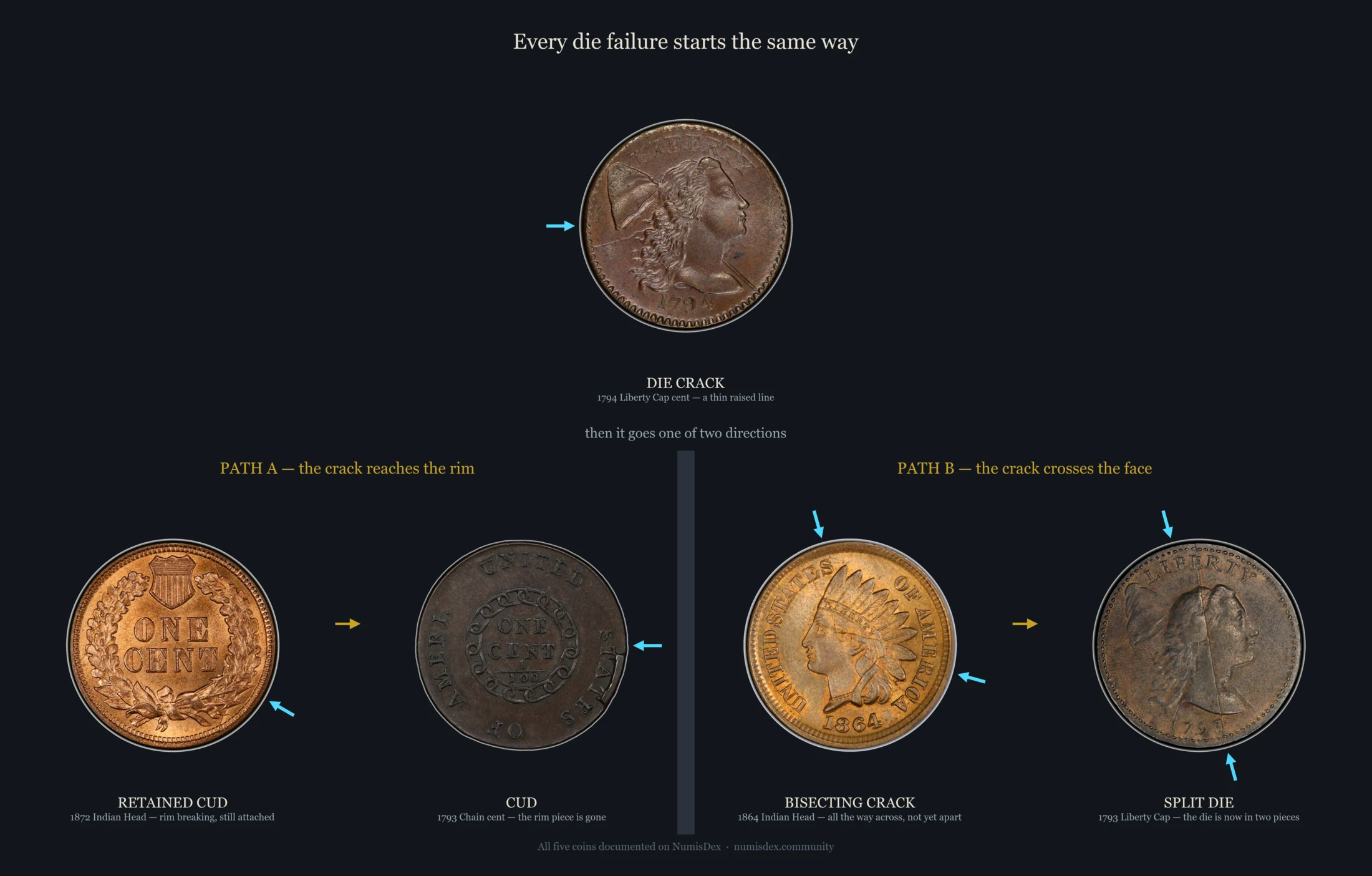
Every failure starts the same way. Repeated striking under enormous pressure stresses the die steel. The stress finds a weakness — an internal flaw, an inconsistent hardening, a design element that concentrates force — and a crack starts. From there it goes one of two directions:
- Path A — the crack reaches the rim. A piece of the die edge begins to break away. First it cracks and shifts while staying attached, which produces a retained cud on struck coins. Once it separates completely you get a full cud: a raised, featureless mass of metal where the rim detail used to be.
- Path B — the crack crosses the face. It propagates through the interior of the die, through design elements, until it reaches the rim on the far side. That is a bisecting rim-to-rim die crack — the die has been cut all the way across but the halves have not yet shifted. When they do begin to shift against each other under load, you have a split die.
Path A is peripheral. Path B is diametric. A coin can show both, but neither one leads to the other. And not every crack goes anywhere at all — most dies get pulled from service first.
This is why collectors mix up cuds and split dies: same origin, same cause, same failing die steel. It is also why the distinction matters. They tell you completely different things about how the die was dying.
What to Look For
- A raised line that runs rim to rim. Not partway. Full diameter. This is the single defining diagnostic.
- Consistent width and metallic character along its length. A split-die ridge is struck metal, so it has the same surface and luster as the rest of the coin. A scratch is post-strike damage and looks like it.
- The line crosses design elements without respecting them. It runs through letters, through the portrait, through devices — because the crack in the steel did not care where the design was.
- Displacement across the ridge. Design elements on one side sit slightly offset relative to the other side.
That last one is the tell that separates a split die from a very long die crack. A crack gives you a line. A split gives you a line with a step in it.
The 1793 Liberty Cap
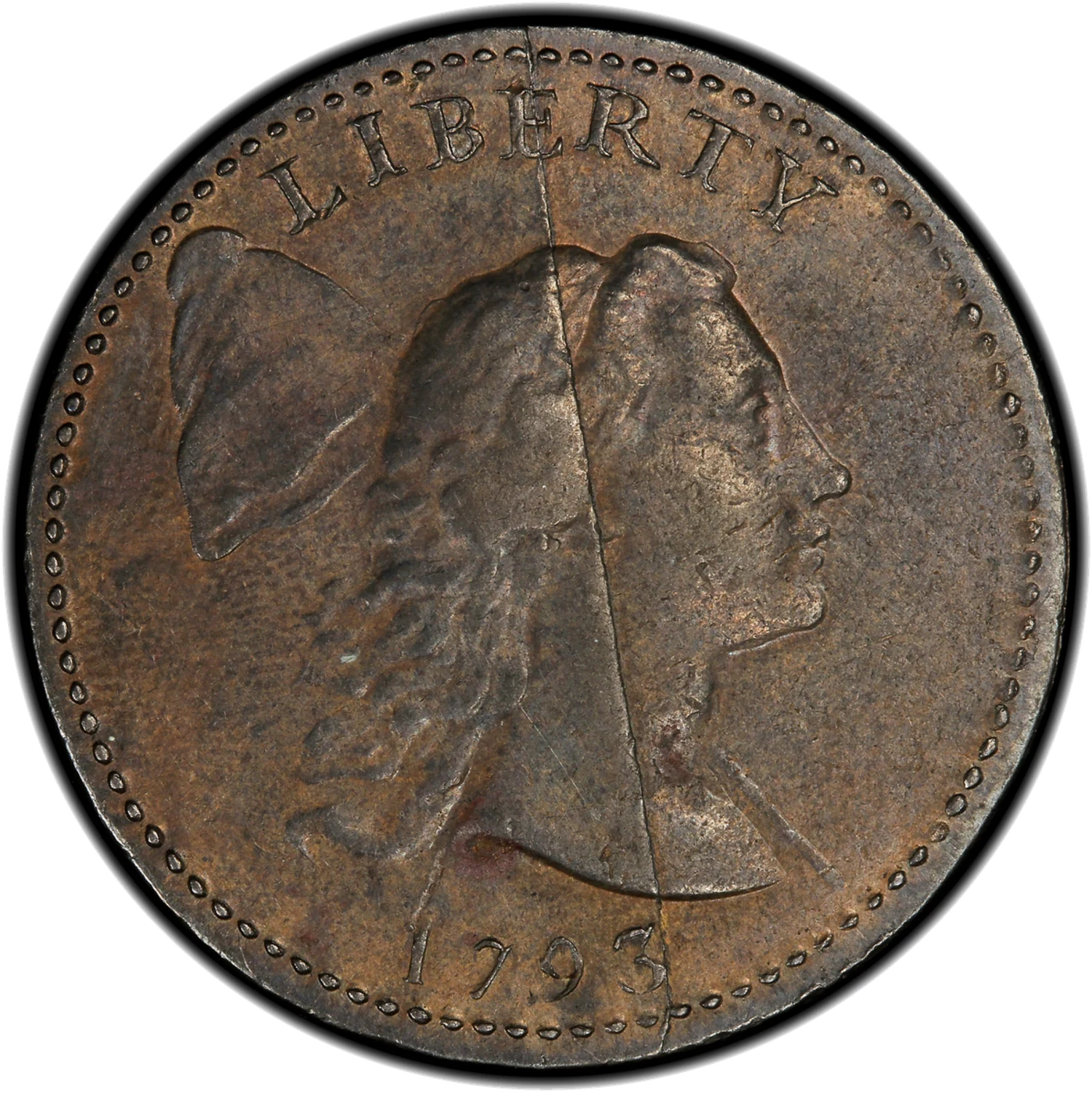
This is the clearest split die in our catalog and a good coin to train your eye on. The crack runs from the rim along the outside edge of the "3" in the date, straight up through Liberty, and out through the "E" in "LIBERTY." Follow the ridge from bottom to top — once you see it, you cannot unsee it.
The 1793 Liberty Cap cent was the second design type used for large cents and was produced in very limited quantities, which makes a die failure this severe on the type genuinely notable.
227 Years of the Same Failure
The NumisDex catalog documents 49 split dies spanning 1793 to 2020 — from the Mint's first year of large cent production to a Philadelphia cent struck during the pandemic coin circulation disruption. By denomination: 20 dimes, 19 cents, 2 nickels, with the remainder across early copper.
A few worth knowing:
- 1793 Chain Cent (AMERI. variety), reverse. The first large cent the United States Mint produced. The crack runs from the rim between the "M" and "E" in "AMERI.", through the chains, and out through the first "T" in "STATES."
- 1796 Draped Bust Large Cent (Reverse of 1795). Two cracks, both rim to rim, running parallel. The first originates just counter-clockwise of the fraction 1/100 and travels through "RICA" of AMERICA before reaching the rim between "E" and "R."
- SD-1c-1909-01, the 1909 VDB Lincoln cent. The first and only documented split die on the most famous first-year issue in American numismatics. Philadelphia struck roughly 27.99 million VDB cents before the designer's initials were pulled following public outcry.
- SD-10c-1838-01, an 1838 Seated Liberty dime. A median split — the fracture runs approximately through the center of the die rather than off-axis.
- SD-1c-2020-01R, a 2020-P Lincoln Shield cent. Reverse split die. Proof that this is not a nineteenth-century problem.
Browse all 49 split die listings in the NumisDex catalog.
Split Die vs. Die Crack vs. Cud
| Where it is | What it looks like | Die still intact? | |
|---|---|---|---|
| Die Crack | Anywhere on the die face | Thin raised line, does not span the coin | Yes — cracked, not broken |
| Cud | At the rim | Raised featureless blob, rim detail gone | No — a piece of the rim broke off |
| Split Die | Across the entire face | Raised ridge rim to rim, design offset either side | No — the die is in two or more pieces |
Why the Mint Kept Striking
The obvious question is why anyone would run a die that has come apart. The answer is that die inspection was periodic, not continuous, and a press producing hundreds of coins per minute produces a great many coins between inspections.
On early Mint coinage the calculus was harsher still. Die steel was expensive, die-sinking was slow and entirely manual, and production quotas did not care about a ridge across the reverse. Every split die in the catalog is a record of that decision.
Related Reading
- Cuds: When Dies Break at the Rim — the other branch of the same failure, where the crack reaches the rim instead of crossing the face
- Die Crack vs. Die Chip vs. Cud: How to Tell Them Apart — the earlier stages, before a die gets anywhere near coming apart
- Split Planchets: When a Coin Breaks in Half — not the same thing. A split planchet is the coin metal delaminating; a split die is the tool breaking. Same word, opposite side of the press
- Repunched Mint Marks (RPM): What They Are and How to Find One — a hub/punch error rather than a die failure, and a useful contrast
- Broadstrikes: Full Design, No Collar — failure of the collar rather than the die itself
Have a split die we have not catalogued? Post it below — we are actively building this record.
0 Replies
Related Threads
- Spiked Heads: When the Portrait Grows a Horn0 replies · yesterday
- 50c-2026-D-DBK or DIC0 replies · 1w ago
- What Is a BIE Error on a Lincoln Cent, and Is It Worth Anything?0 replies · 3mo ago
- Die Crack vs. Die Chip vs. Cud: How to Tell Them Apart0 replies · 3mo ago
- When a Die Dies: How Cuds Form and Why Every Stage of Failure Is Collectible0 replies · 3mo ago