
Spiked Heads: When the Portrait Grows a Horn
Spiked HeadA Die Crack With a Memorable Shape
A spiked head is a die crack that runs from the rim into the portrait and produces a raised spike — a thorn, a horn, a spear — projecting off the head of whoever is on the coin.
The mechanism is ordinary die failure. Under repeated striking, a crack starts at the rim and propagates inward. On a coin with a bust on the obverse, the highest relief is the portrait, and cracks tend to run toward and into it. When they do, metal flows up into the fissure on every strike, and the result is a thin raised line rising from the head like something growing out of it.
What makes it a named category rather than "a die crack" is the picture. A crack through a wreath is a crack. A crack that gives Lincoln a unicorn horn is a spiked head.
It Is Not a Lincoln Cent Thing
Because Lincoln cents are the most collected coin in the country, spiked heads are usually discussed as a Lincoln cent phenomenon. They are not. Any coin with a portrait on it can produce one.
The NumisDex catalog holds 1,510 spiked heads across 21 series, from 1794 to 2025. Lincoln accounts for most of them — 712 Memorial, 308 Shield, 264 Wheat — because Lincoln accounts for most of the coins. But the list runs through Washington quarters (50 clad, 39 State Quarters), Jefferson nickels (37), Roosevelt dimes (50 across silver and clad), Mercury dimes (19), Kennedy halves, Buffalo nickels, Presidential dollars, a Susan B. Anthony, a Flying Eagle, and a handful of early copper.
The earliest is a 1794 Liberty Cap large cent — the second year of regular cent production — with a crack rising from the rim through the "4" of the date into Liberty's hair. That is 115 years before there was a Lincoln cent.
Three to Learn From
1794 Liberty Cap Large Cent
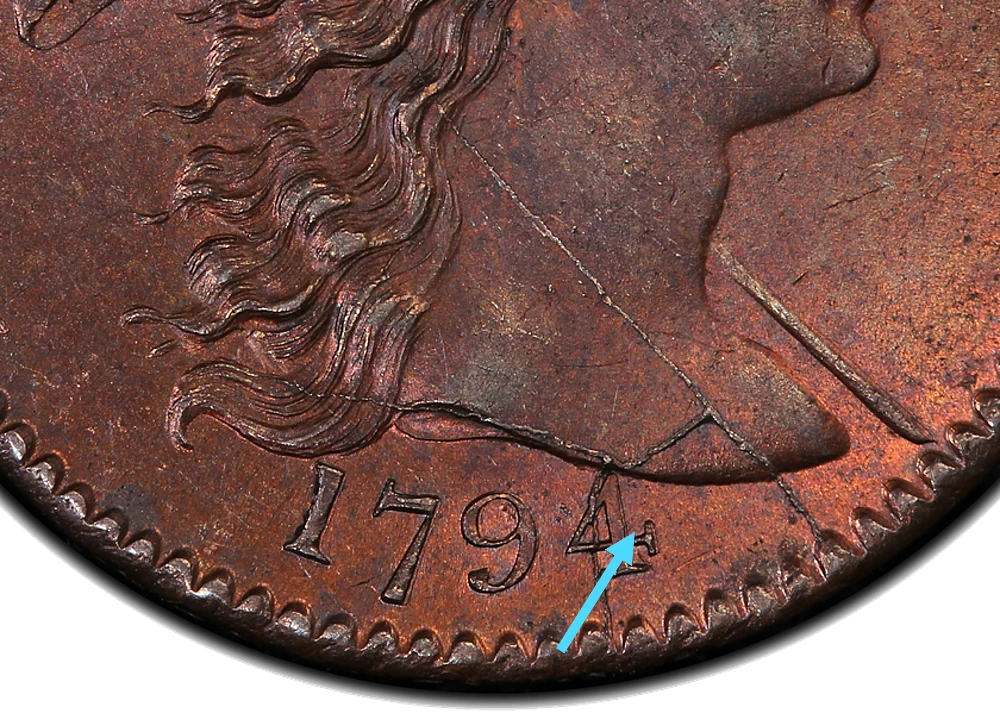
Two cracks; the main one enters at the rim through the 4 in the date and runs up into the hair and neck, branching as it climbs. Follow the arrow and the crack is unmistakable — a raised line cutting straight across the field. This is the oldest spiked head we have catalogued, on a coin struck when the Mint was two years old. See the listing.
1909 VDB Lincoln Wheat Cent
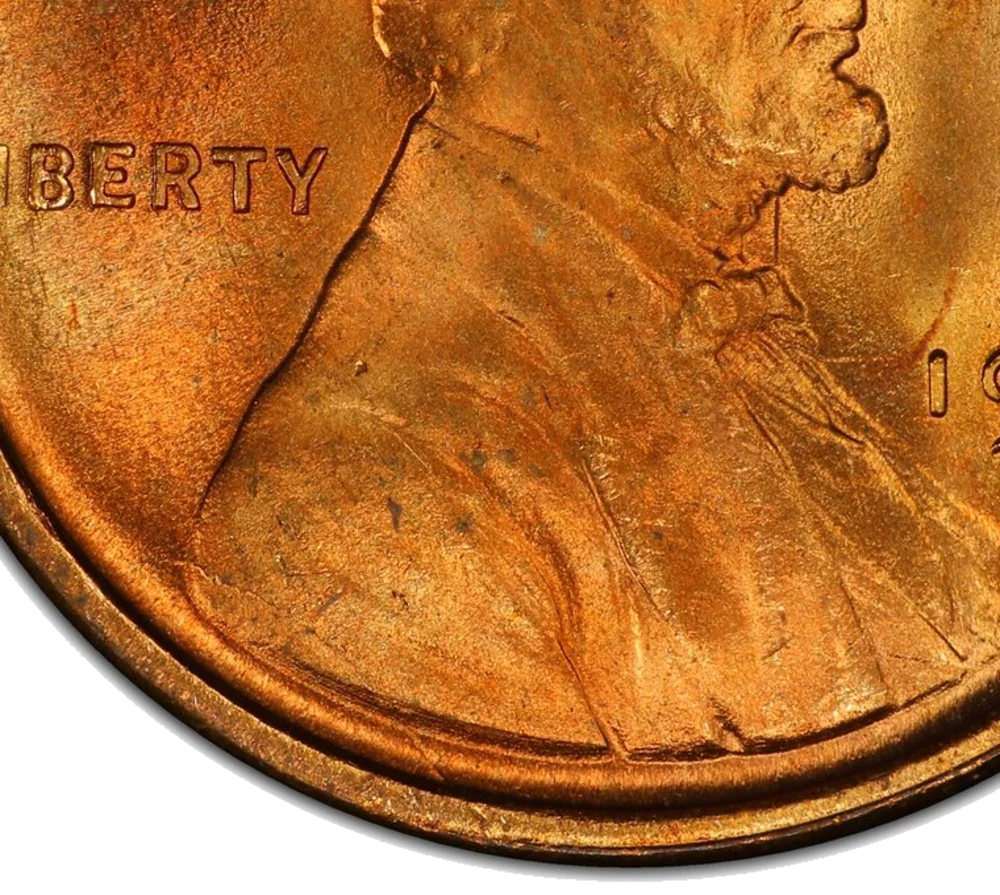
The very first year of the Lincoln design. A crack runs from the back of Lincoln's shoulder down to about 6:30 on the rim. Not the classic "horn off the top of the head" shape — spikes can emerge from anywhere on the portrait, and this one comes off the shoulder. See the listing.
1952 Roosevelt Dime — SKH-001
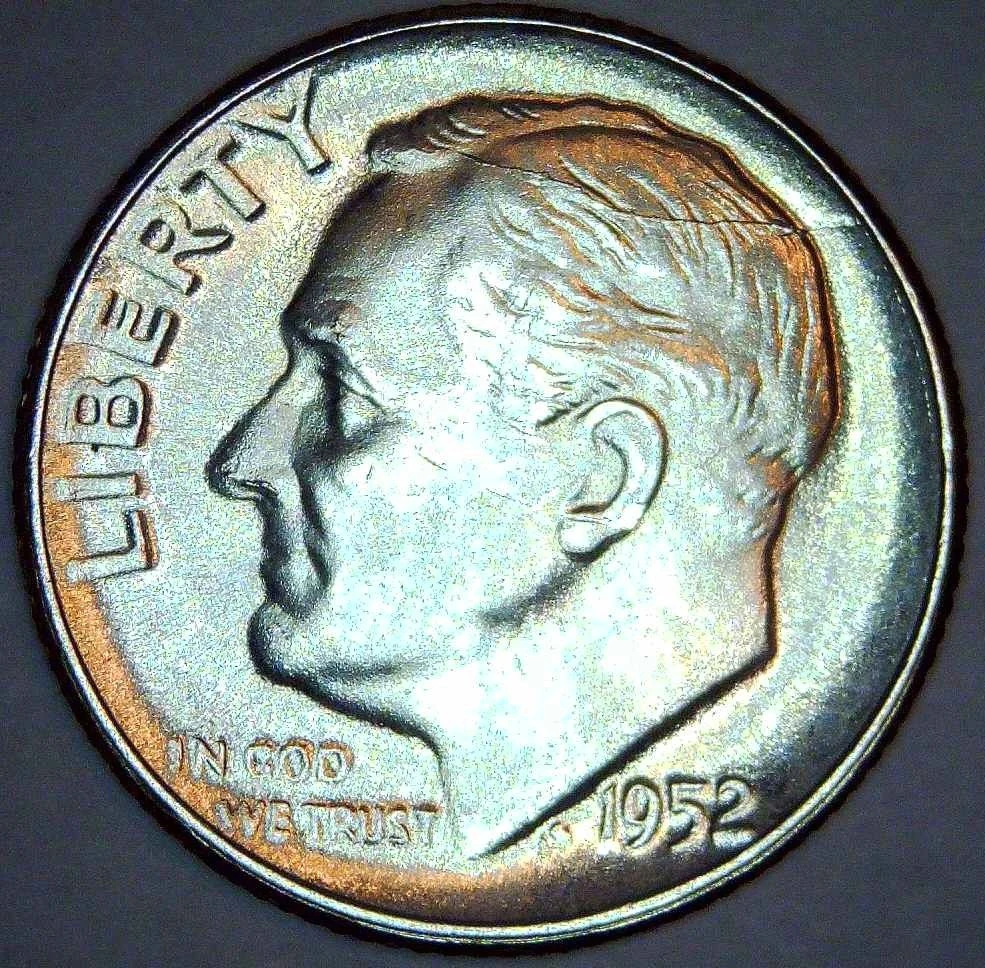
And it isn't even a cent. A raised spike runs from the top of Roosevelt's head to the rim on this 90% silver dime — the same die-crack mechanism, a completely different denomination. This is SKH-001, the first spiked head catalogued for the 1952 dime. If you only ever check Lincoln cents, this is the coin that proves you're missing them everywhere else. See the listing.
How to Tell It From Damage
- Raised, not incuse. A spiked head stands up from the surface, because metal flowed into a crack in the die. A scratch cuts into the coin. Tilt it under a light — a spike catches the light along its top edge.
- Consistent metallic character. It has the same luster and surface as the field around it. Post-strike damage looks different — brighter, duller, or with displaced metal at the edges.
- It starts at the rim. Nearly always. A raised line that begins in the middle of the field with no connection to the rim is more likely a die gouge or a different failure.
- It follows the die, not the coin. Every coin struck from that die state shows the same spike in the same place. Find a second example with an identical spike and you have confirmed it.
Where It Sits in the Die-Failure Family
A spiked head is a die crack that happens to run into the portrait. It belongs to the same family as the cuds and split dies we have covered before — all of them are die steel failing under striking pressure — but it is usually caught early. A crack that reaches the portrait has not necessarily reached the opposite rim (that would be a bisecting crack), and it has not broken a piece of the rim away (that would be a cud). It is a crack with a distinctive location and a distinctive look, and that is enough to earn it a name.
The Catalogue
Spiked heads are attributed by Cuds on Coins under the prefix SKH — SKH-1c-1941S-01 is the first spiked head catalogued for the 1941-S cent, and the number climbs as new die states are found. Our 1,510 listings carry those designations and, in nearly every case, a photograph.
Browse all 1,510 spiked head listings in the NumisDex catalog.
Discussion
- What is the strangest place you have seen a spike emerge from a portrait?
- Do you have a spiked head on a non-Lincoln coin? We would like to see it.
- Spiked head or scratch — what is your go-to test?
Related Reading
- Die Crack vs. Die Chip vs. Cud: How to Tell Them Apart — the wider family a spiked head belongs to
- Split Dies: When the Die Comes Apart — what happens when a crack keeps going all the way across
- Cuds: When Dies Break at the Rim — the other direction a rim crack can take
- What Is a BIE Error on a Lincoln Cent? — another named die break with a memorable shape
- 1952 Roosevelt dime "Spiked Head" die crack — a member's find, and a good non-Lincoln example
0 Replies
Related Threads
- 50c-2026-D-DBK or DIC0 replies · 1w ago
- Split Dies: When the Die Comes Apart0 replies · 2w ago
- What Is a BIE Error on a Lincoln Cent, and Is It Worth Anything?0 replies · 3mo ago
- Die Crack vs. Die Chip vs. Cud: How to Tell Them Apart0 replies · 3mo ago
- When a Die Dies: How Cuds Form and Why Every Stage of Failure Is Collectible0 replies · 3mo ago