
Overdates: When Yesterday's Date Won't Let Go
OVDTwo Dates on One Coin
An overdate is a coin where a new date has been punched over an existing date on a working die. The old date's remnants — curved lines, bases, serifs of the previous digit — remain visible underneath or beside the new date. The result is a coin that shows two dates at once: the one the Mint intended, and the ghost of the one that came before.
Overdates aren't accidents. For most of American coinage history, they were standard practice — a cost-saving measure at a Mint that couldn't afford to waste serviceable dies. Understanding overdates means understanding how the early United States Mint actually operated: on a tight federal budget, with hand-engraved tooling that was too valuable to discard after a single year.
Why the Mint Did It
In the early US Mint (1790s through the 1830s), each die was hand-engraved and hand-punched. Making a new die required a skilled engraver to cut the design elements, punch the date digit by digit, and add the stars and lettering — all by hand. Dies wore out from repeated striking, but many were still mechanically serviceable at the end of a calendar year. The only thing wrong with them was the date.
The solution was straightforward: take the old die, position a punch with the new year's digit over the old one, and strike it with a hammer. An 1817 die becomes an 1818 die. The old "7" doesn't disappear entirely — its remnants persist in the steel under the new "8" — but the new date is dominant, and the coin is ready for another year of service.
This was economics, not error. Congress allocated limited funds to the Mint, and die production was a significant expense. Reusing dies by overdating them was simply good stewardship of public resources. The practice was routine across all denominations: cents, half cents, silver coins, and gold coins alike.
What to Look For
The old date digit usually appears as faint remnants of curves, uprights, or serifs that don't belong to the current digit. Magnification of 10x to 20x is typically required — most overdates are not visible to the naked eye.
Common signatures:
- An "8" over a "7" often reveals the angular top of the "7" within the upper loop of the "8." The "7" has a flat horizontal bar; the "8" has a curved upper loop. Where they overlap, the straight line of the "7" shows through the curve.
- A "3" over a "2" may show the bottom horizontal bar of the "2" extending below the lower curve of the "3."
- A "9" over an "8" shows the lower loop of the "8" beneath the tail of the "9." The "8" is symmetrical; the "9" isn't. The mismatch is the tell.
Examples from the NumisDex Catalog
1883 Shield Nickel — 1883/2 Overdate (WOVD-001)
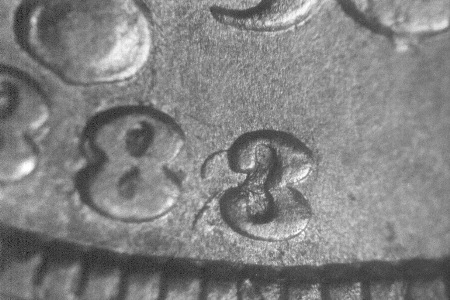
A close-up of the date area showing the "3" punched over a "2." The base of the old "2" is visible beneath the lower curve of the "3." The Shield Nickel (1866–1883) was the first US five-cent coin — this overdate occurred in the series' final year of production.
1880-O Morgan Dollar — 1880/79 Overdate (WOVD-001)
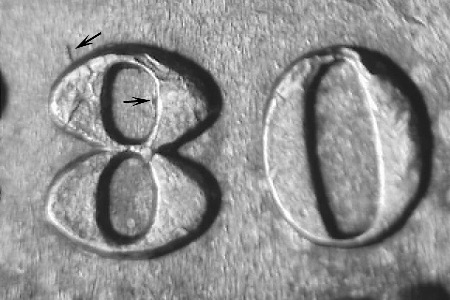
The "7" of 1879 is visible beneath the "8" of 1880 — the angular top bar of the "7" shows through the upper loop of the "8." The New Orleans Mint produced Morgan Dollars from 1879 to 1904, and die reuse between years was common practice. This coin also shows strong die clash marks on both sides, indicating the die pair had additional production stress.
1887-O Morgan Dollar — 1887/6 Overdate (WOVD-001)
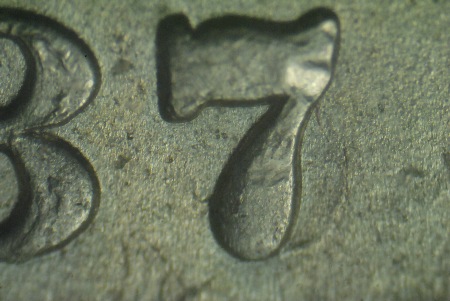
Another New Orleans Mint Morgan Dollar overdate, this time with the "7" of 1887 punched over the "6" of 1886. The rounded base of the "6" is visible beneath the straight descender of the "7." Morgan Dollar overdates are among the most actively collected overdate varieties in American numismatics — the large size of the coin makes the underlying digit easier to study under magnification.
1892-S Liberty Head Double Eagle — 1892/1 Overdate (WOVD-001)
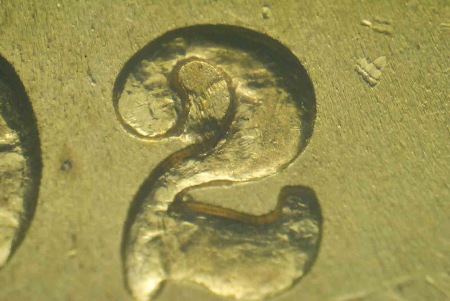
Overdates on gold coins. The final digit "2" of 1892 was punched over a "1" from an 1891-dated die. This is a $20 Liberty Head Double Eagle from the San Francisco Mint — one of the largest and most valuable denominations ever struck by the United States. Gold coin overdates from this era document die reuse even on high-denomination coinage where individual dies struck fewer coins due to the softer gold alloy and higher striking pressures.
1909 Saint-Gaudens Double Eagle — 1909/8 Overdate (WOVD-001)
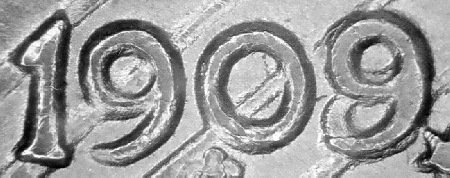
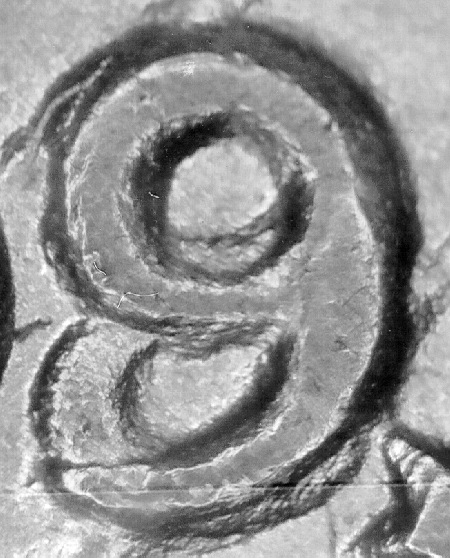
A Saint-Gaudens Double Eagle with the "9" of 1909 punched over an "8" from a 1908-dated die. The lower loop of the old "8" is visible beneath the tail of the "9." Augustus Saint-Gaudens' striding Liberty design (1907–1933) is considered the most beautiful coin ever struck by the United States — and even these masterpieces weren't immune to the economics of die reuse. This overdate is one of the last examples before mechanized die production largely eliminated the practice.
The Transition: From Economy to Error
As die manufacturing became more mechanized in the mid-1800s, overdates became less common. By the early 1900s, the Mint's production technology had advanced to the point where making a new die was no longer a significant expense. The 1909 Saint-Gaudens overdate above is one of the last "economy" overdates — a die reused to save cost rather than by mistake.
The few overdates that occurred in the 20th century were genuine errors, not cost-saving measures:
- 1918/7-S Standing Liberty Quarter — the "7" of 1917 is clearly visible under the "8" of 1918. One of the most valuable regular-issue 20th century coins. The date area on Standing Liberty quarters wore quickly, making surviving examples with readable overdates especially scarce.
- 1918/7-D Buffalo Nickel — same overdate concept at the Denver Mint. The "7" is visible under the "8."
- 1942/1 Mercury Dime (P and D) — the most famous 20th century overdate. 1941-dated dies were overdated to 1942 at both Philadelphia and Denver. The "1" is clearly visible under the "2." One of the most collected error coins in American numismatics.
These 20th century overdates are genuine mistakes — someone grabbed a wrong-year die and punched the current date over it, or the die manufacturing process introduced the error mechanically. The economic rationale was gone; these were production errors that slipped through quality control.
Not to Be Confused With
- Repunched Date (RPD): The same date punched twice at slightly different positions or angles. The digit is doubled, not changed to a different number. An RPD shows two impressions of the same digit; an overdate shows two different digits.
- Repunched Mint Mark (RPM): The same concept applied to the mint mark letter rather than the date. A "D" over a "D" at a different angle is an RPM, not an overdate.
- Over Mint Mark (OMM): When one mint mark is punched over a different mint mark — for example, a "D" over an "S." This is the mint-mark equivalent of an overdate. Read more in our RPM guide.
- Doubled Die: The entire die image is doubled due to a hub misalignment during die manufacturing. All design elements are affected, not just one digit. Doubled dies produce consistent doubling across the entire coin; overdates affect only the date.
Collecting Overdates
Overdates span nearly every denomination and era of US coinage. Early copper (large cents, half cents), early silver (half dollars, quarters, dimes), early gold ($2.50, $5, $10), and Morgan Dollars all have well-documented overdate varieties. The examples above cover just a fraction — from Shield Nickels to Saint-Gaudens Double Eagles.
The two gold coin overdates shown here — the 1892-S Liberty and the 1909 Saint-Gaudens — demonstrate that die reuse was practiced even on the Mint's highest-value denominations. Gold dies experienced higher stress and wore faster than copper or silver dies, which made die conservation even more important for these expensive denominations.
Browse overdate listings in the NumisDex catalog.