
1873 Three Dollar Patterns
Base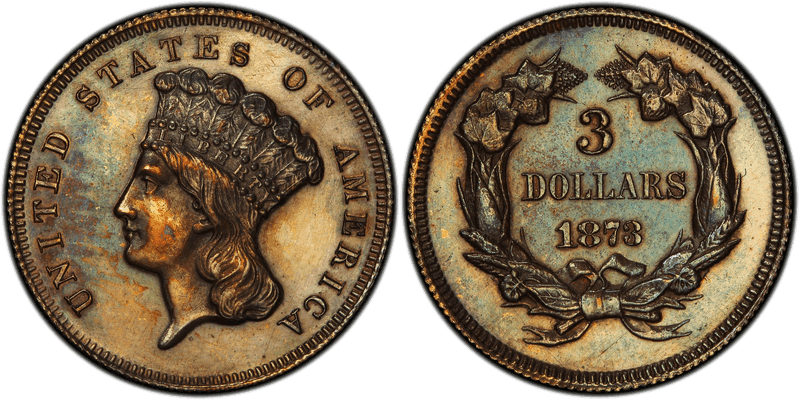
About This Coin
Within the Trade Dollar Era Patterns (1871-1873), the 1873 Three Dollar Patterns represent William Barber's redesign of one of the most unusual denominations in American numismatics. The three-dollar gold piece, introduced in 1854 primarily to facilitate purchase of three-cent postage stamp sheets, had never achieved widespread circulation and was already regarded as an oddity. Barber's obverse features the seated Liberty facing left with olive branch and wheat sheaf, replacing the distinctive Indian Princess design by Longacre that had defined the denomination since inception. The reverse displays an eagle perched on a bale of goods with olive branch and three arrows, applying the Trade Dollar era's commercial vocabulary to a denomination more associated with postal convenience than international trade. A notable result of $6.3K in PR61BN grade at Heritage Auctions makes this among the more affordable entries in Barber's 1873 suite, partly because the denomination has a smaller collector following. For numismatic historians, the 1873 Three Dollar Patterns offer a glimpse of an alternative artistic direction the denomination might have taken had Barber's comprehensive redesign been adopted.
Specifications
Strike Types & Varieties(2)
1873 Proof Three Dollar Pattern - J-1335

1873 Proof Three Dollar Pattern - J-1336
Other Base Coins in This Series


Collector Essentials
Tools and references for building and protecting your coin collection.
10x-20x Jeweler's Loupe
A must-have for examining coin details, mint marks, and surface quality
Red Book — Guide to U.S. Coins
The essential annual reference for U.S. coin values, history, and mintages
Coin Albums & Storage
Archival-quality albums and holders to protect and display your collection
USB Digital Microscope
Capture detailed images for documentation and community submissions
As an Amazon Associate, NumisDex earns from qualifying purchases.