
RCD-5c-1867-08 & 09 Retained Cud
Error
Description
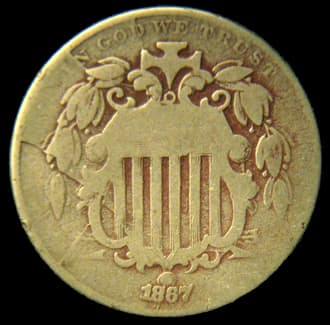
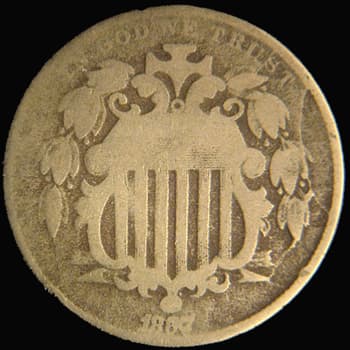
Dual-cataloged under entries 08 and 09, this retained cud on the 1867 Shield Nickel with Rays documents a significant die failure on one of the earliest United States nickel five-cent pieces. The designation RCD-5c-1867-08 & 09 from the Cuds on Coins catalog indicates that two distinct retained cud areas were identified on the same die, substantial enough to warrant individual catalog numbers while being recognized as products of the same die. A retained cud forms when a section of die steel bounded by rim cracks has begun to separate from the die body but remains physically attached — the resulting struck coins show a raised, irregular mass of metal in the affected area, with the original design partially or fully obscured within the retained fragment. James B. Longacre's Shield nickel, featuring a prominent shield on the obverse and a large numeral 5 surrounded by stars and rays on the reverse, debuted in 1866 as the first base-metal five-cent coin in U.S. history. The 1867 "With Rays" variety represents the second and final year of the rays design, as the ray pattern between the reverse stars was removed mid-year to improve die life — the rays created opposing high-relief elements that accelerated die wear and failure. Philadelphia struck approximately 2.02 million Shield nickels with rays in 1867 before transitioning to the no-rays design. The hard 75% copper / 25% nickel alloy demanded higher striking pressure than any previous U.S. coin composition, and the dual retained cud on this die exemplifies the severe stress that the new alloy imposed on die steel. Collectors should examine examples under 5-10x magnification looking for raised, blob-like areas near the rim where crack-bounded die fragments remained attached during striking.
Attribution History
- Discovered by Chuck Newman
- Expert attribution by Cuds on Coins
External References
Community & Reference
Related Errors
More Retained Cud Errors
Collector Essentials
Tools for examining and preserving error coins and die varieties.
10x-20x Jeweler's Loupe
Essential for examining die varieties, doubled dies, and RPMs
Cherry Picker's Guide
The definitive reference for U.S. error coins and die varieties
2x2 Coin Flips & Holders
Protect and organize your finds with archival-quality holders
USB Digital Microscope
Capture detailed images for documentation and community submissions
As an Amazon Associate, NumisDex earns from qualifying purchases.