
1847 Braided Hair Large Cent Newcomb-7 Obverse Rim Cud
Error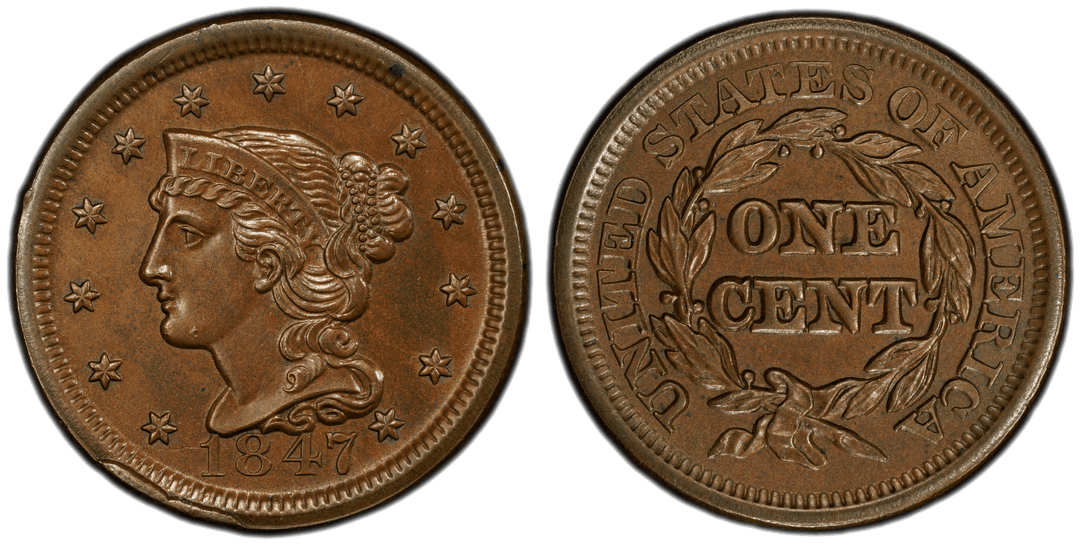
Community Voting
This listing needs 10.0 weighted votes to advance to community review.
Description
Attributed as Newcomb-7 (N-7), this 1847 Braided Hair large cent carries an obverse rim cud between the 6 o'clock and 7 o'clock positions where a section of the obverse die fractured and separated along the rim, producing a raised featureless area on Liberty's side of the coin. Christian Gobrecht's Braided Hair design places Liberty's elaborately braided portrait within a ring of thirteen stars, and a cud in the lower-left quadrant potentially affects one or more of the lower stars or the hair detail near the base of Liberty's portrait. Philadelphia struck approximately 6.18 million large cents in 1847, a substantial increase over recent years that reflected continued demand for the copper cent despite growing calls for a smaller denomination — a transition that would eventually come with the introduction of the Flying Eagle cent in 1857. Obverse cuds on large cents are particularly noteworthy because the obverse die (the anvil die in this era's coining presses) typically experienced different stress patterns than the reverse (hammer) die, and the location of failures provides metallurgical insight into die usage patterns. The Newcomb attribution system assigns N-7 to a specific obverse-reverse die pair, meaning this cud developed on the obverse die of die marriage number 7 for the 1847 date. Rim cuds represent terminal die failure — once a section of the rim breaks away, the die is functionally compromised and would typically be removed from service, though some cuds grew progressively larger when dies remained in use after the initial break. The raised featureless mass fills the space where normal design detail should appear, with a sharp boundary where the intact die surface meets the void left by the missing fragment. Collectors should examine the lower-left rim area of the obverse for the characteristic raised blob with clean boundaries against the surrounding normally struck design.
Attribution History
- Discovered by NumisDexDealer
- Newcomb N-7
Community & Reference
Learn About Cud
How this error occurs, identification tips, and collecting guide
Discuss in Forum
Join the community conversation about Cent
Catalog Status
Related Errors


More Cud Errors
Collector Essentials
Tools for examining and preserving error coins and die varieties.
10x-20x Jeweler's Loupe
Essential for examining die varieties, doubled dies, and RPMs
Cherry Picker's Guide
The definitive reference for U.S. error coins and die varieties
2x2 Coin Flips & Holders
Protect and organize your finds with archival-quality holders
USB Digital Microscope
Capture detailed images for documentation and community submissions
As an Amazon Associate, NumisDex earns from qualifying purchases.