
The Half Dollar: From America’s Workhorse Coin to Its Rarest Pocket Change
The Coin America Actually Used
For 150 years, the half dollar was the coin that made American commerce work. Before paper currency became ubiquitous, the half dollar was the standard medium for large transactions — the denomination people reached for when they needed more purchasing power than cents, dimes, and quarters could provide. Half dollars circulated more heavily than any other silver coin in the United States.
Today, you almost certainly don’t have a half dollar in your pocket. The Kennedy half dollar is still minted every year — the U.S. Mint produces them annually — but almost none enter circulation. They go straight into bags and rolls for collectors. The half dollar went from America’s most-used large-denomination coin to a denomination most Americans never encounter in daily life.
That transformation — from workhorse to wallflower — is one of the most interesting stories in American numismatics.
Eight Designs Across 230 Years
Flowing Hair (1794–1795)
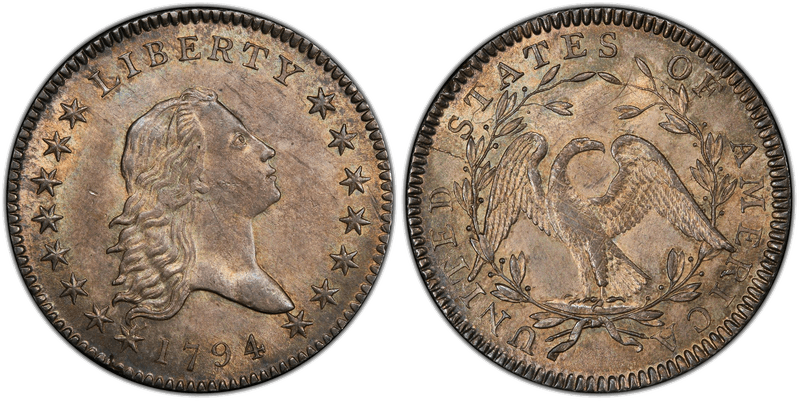
The first half dollar struck by the United States Mint. Robert Scot’s Liberty with flowing hair on the obverse, a small eagle within a wreath on the reverse. Only two years of production. Every surviving example is rare, and the 1794 is among the most sought-after dates in all of American numismatics. These coins were struck on hand-operated screw presses, one at a time, and the early Mint’s equipment was barely adequate for the task — many examples show weak strikes, particularly at the centers.
Draped Bust (1796–1807)
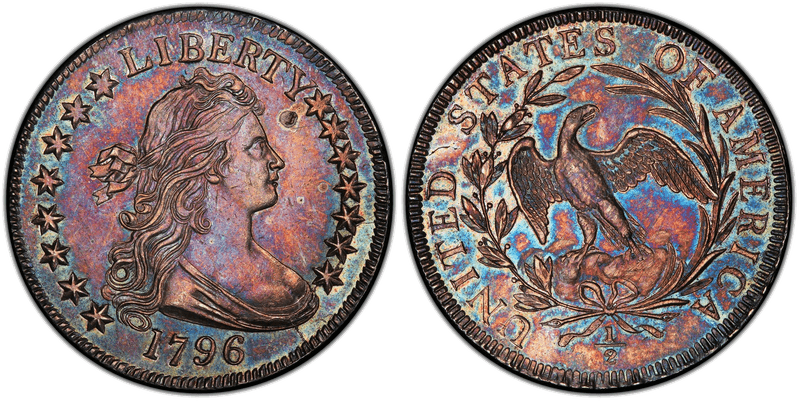
Gilbert Stuart’s idealized portrait of Liberty with draped bust. Two reverse subtypes: the Small Eagle reverse (1796–1797) and the Heraldic Eagle reverse (1801–1807). The 1796–1797 half dollars with the Small Eagle reverse are among the rarest regular-issue U.S. coins — only about 3,900 were struck across both dates. A 1796 half dollar with 15 stars (representing the 15 states at the time) is a coin that most collectors will never hold.
Capped Bust (1807–1839)
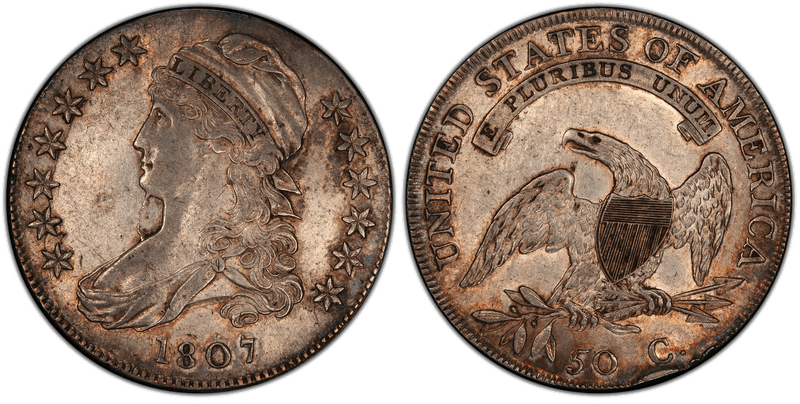
John Reich’s bold design: Liberty wearing a Phrygian cap, facing left. Two major subtypes define this era. The Lettered Edge variety (1807–1836) has “FIFTY CENTS OR HALF A DOLLAR” stamped into the edge before striking. The Reeded Edge variety (1836–1839) switched to the machine-applied reeded edge still used today and reduced the size of the coin. The 1807 “Bearded Goddess” variety — where a die crack across Liberty’s chin creates the appearance of a beard — is one of the great named varieties in American numismatics. The 1838-O, struck at the New Orleans Mint with only 20 examples produced, is one of the rarest and most mysterious half dollars: were they patterns, test strikes, or something else entirely?
Seated Liberty (1839–1891)
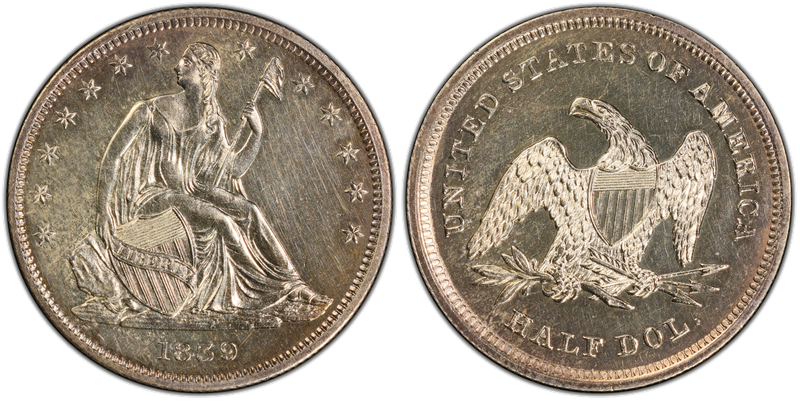
Christian Gobrecht’s seated figure of Liberty holding a pole with a Phrygian cap — the longest-running half dollar design at 52 years. This series has more subtypes than any other half dollar: No Motto (1839–1866), Arrows at Date (1853–1855, indicating a weight reduction), Rays on Reverse (1853 only), With Motto (1866–1891, adding “IN GOD WE TRUST” to the reverse), and a second Arrows period (1873–1874, for a slight weight increase). The Seated Liberty half dollar was the workhorse of American commerce through the Civil War, westward expansion, and the Gilded Age.
Barber (1892–1915)
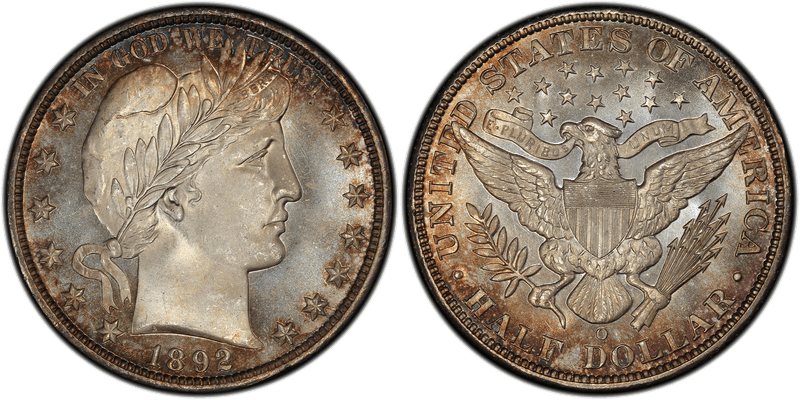
Charles Barber’s Liberty Head design — a classical female profile wearing a laurel wreath and Phrygian cap. The Barber half dollar is part of a matched set: Barber designed the dime, quarter, and half dollar simultaneously, giving all three denominations the same obverse portrait. Barber halves were workhorses of everyday commerce, and heavy circulation wear makes high-grade examples surprisingly scarce. Key dates include the 1892-O (first New Orleans issue), the 1893-S, and the 1904-S.
Walking Liberty (1916–1947)
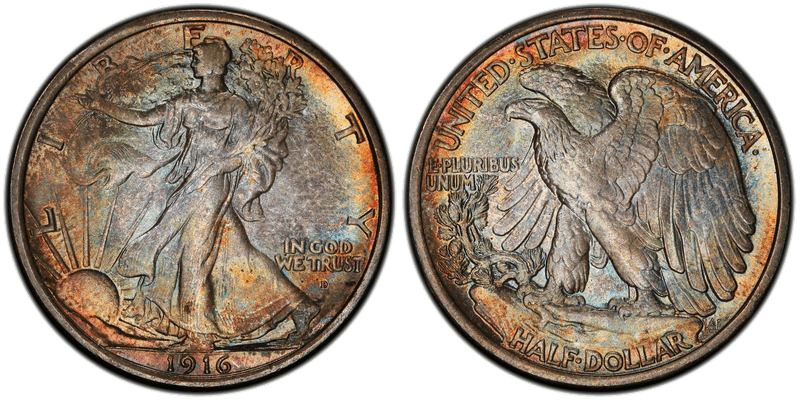
Adolph Weinman’s masterpiece. Liberty strides confidently toward the sunrise, draped in an American flag, reaching toward a future of freedom and opportunity. The reverse features a majestic eagle perched on a mountain crag. Widely considered the most beautiful coin design ever produced by the United States Mint, the Walking Liberty half is the standard against which all other U.S. coin designs are measured.
The design was so iconic that when the U.S. Mint launched the American Silver Eagle bullion program in 1986, they chose Weinman’s Walking Liberty for the obverse — making it the face of the world’s best-selling silver bullion coin. Every Silver Eagle ever minted carries the same design that first appeared on half dollars 70 years earlier.
Key dates: the 1916-S and 1921-S are genuinely scarce. The 1916-D shown here was the first Denver Mint issue of the design.
Franklin (1948–1963)
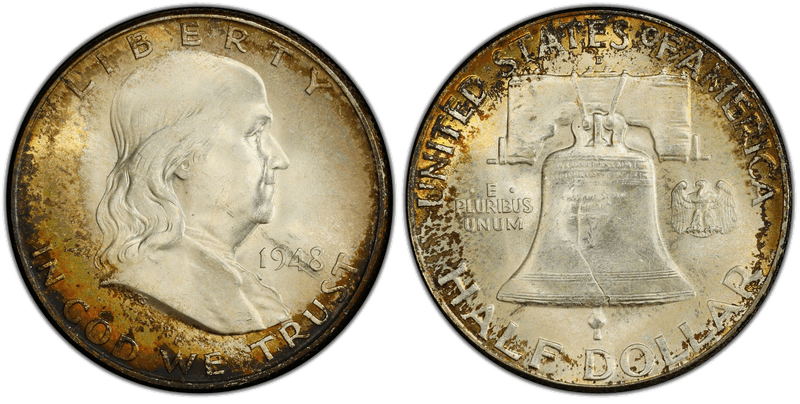
Benjamin Franklin on the obverse, the Liberty Bell (crack and all) on the reverse. Chief Engraver John Sinnock’s design was controversial at the time — Franklin was never a president, and putting a non-president on a circulating coin was unusual. The small eagle to the right of the Liberty Bell was required by law (the Mint Act required an eagle on coins larger than a dime) and has always been criticized as an afterthought.
Franklin halves were abruptly discontinued in 1963 — not because the design had run its course, but because the assassination of President Kennedy created immediate public demand for a coin honoring him. The Franklin half’s 15-year run makes it one of the shorter-lived half dollar designs. Collectors prize “Full Bell Lines” (FBL) examples where the horizontal lines on the Liberty Bell are fully struck and complete.
Kennedy (1964–present)
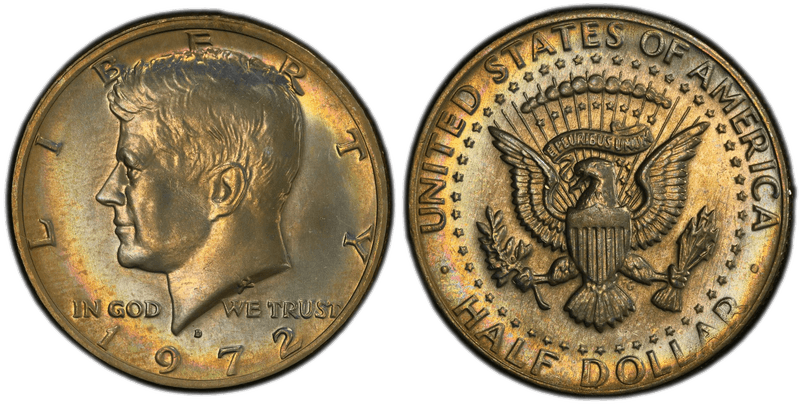
Gilroy Roberts’s portrait of President John F. Kennedy, with Frank Gasparro’s Presidential Seal reverse. The Kennedy half dollar was rushed into production in January 1964, just two months after JFK’s assassination. The first-year 1964 issue was struck in 90% silver, and Americans hoarded them immediately — not as collectibles, but as keepsakes honoring the fallen president.
That hoarding impulse never fully stopped. Kennedy halves have been minted continuously for over 60 years, but they almost never circulate. The Mint produces them, they go into rolls and bags, and collectors absorb them. Banks occasionally have them available if you ask, but you won’t find one in your change.
The silver story mirrors the denomination’s transition: 90% silver in 1964, 40% silver from 1965–1970 (the only denomination to retain partial silver content after the Coinage Act of 1965), and copper-nickel clad from 1971 to the present.
The Silver Transition
The half dollar’s silver history is unique among U.S. denominations:
- 1794–1836: 89.24% silver (early standard)
- 1837–1964: 90% silver (the classic composition)
- 1965–1970: 40% silver clad (silver-clad — the only denomination to keep silver after 1964)
- 1971–present: Copper-nickel clad (no silver content)
The 1965–1970 period is significant: when dimes and quarters went to copper-nickel clad in 1965, the half dollar was the only denomination that retained silver content — reduced to 40%, but still partially silver. This made the 1965–1970 halves targets for silver hoarders, and many were pulled from circulation for their metal content. By the time the half dollar went fully clad in 1971, the public had largely stopped using the denomination.
Why You Can’t Find One
The half dollar’s disappearance from circulation is a combination of factors:
- Size and weight: At 30.6mm diameter and 11.34 grams, the half dollar is significantly larger and heavier than a quarter. As vending machines and parking meters became ubiquitous, the quarter became the practical ceiling for everyday transactions.
- Kennedy hoarding: The emotional attachment to Kennedy’s image meant that half dollars were saved rather than spent, decade after decade.
- Silver content: The 1964 and 1965–1970 issues were hoarded for their silver value, removing them from circulation and breaking the public’s habit of using half dollars.
- Self-reinforcing absence: Once half dollars stopped circulating, businesses stopped ordering them from banks, which meant banks stopped stocking them, which meant the Mint focused production on quarters. The denomination fell into a feedback loop of disuse.
The result: the U.S. Mint still produces Kennedy half dollars every year, primarily for collectors. They’re legal tender, and you can still get them at banks (ask a teller), but they’re the rarest coin you’ll encounter in pocket change — if you encounter one at all.
Key Dates Across the Series
- 1794 Flowing Hair: The first U.S. half dollar. Always in demand regardless of grade.
- 1796 Draped Bust (15 Stars): Mintage of 3,918. One of the rarest regular-issue U.S. coins.
- 1838-O Capped Bust: Only 20 struck. Fewer than 10 survive. A great numismatic mystery.
- 1853-O Seated Liberty (No Arrows): Struck before the mid-year weight change was implemented at New Orleans. Extremely rare.
- 1916-S Walking Liberty: First-year San Francisco issue. Low mintage, heavily circulated.
- 1921 Walking Liberty: Lowest mintage year for the series (246,000). A key date.
- 1948 Franklin: First-year issue. Collected as a type coin.
- 1964 Kennedy: First-year issue, 90% silver. Over 400 million struck, but nearly all were hoarded.
The half dollar’s story — from the backbone of American commerce to a denomination that lives in collectors’ albums rather than cash registers — is one of the most dramatic arcs in U.S. coinage. Eight designs, 230 years, and a coin that went from everywhere to nowhere.
Browse half dollar listings in the NumisDex catalog.
0 Replies
Related Threads
- 2027 Paralympic Half Dollar: CCAC Selects Wheelchair Basketball as First Design0 replies · 3mo ago
- 2027 Paralympic Half Dollar Designs Under Review by CCAC0 replies · 3mo ago
- The Enduring Liberty Half Dollar: Breaking Down the 2026 Semiquincentennial Half Dollar Design0 replies · 3mo ago
- 40% vs. 90% Silver Kennedy Half Dollars: The Complete Composition Guide0 replies · 3mo ago
- Walking Liberty: The Most Beautiful American Coin?0 replies · 4mo ago