
How to Spot a fake 3-legged Buffalo
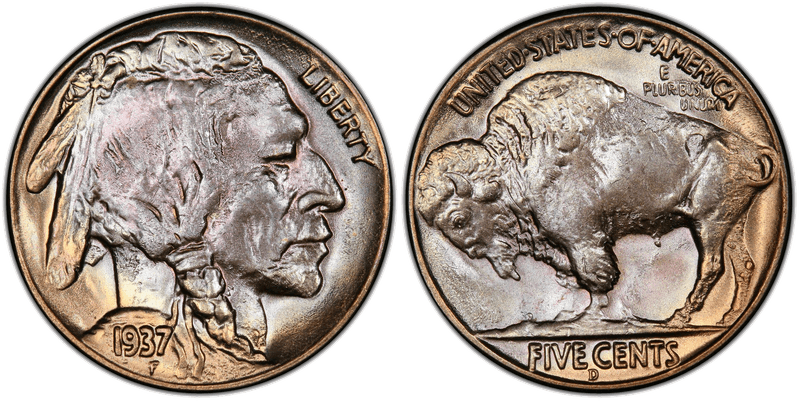
1. Check the Motto (The #1 Tell)
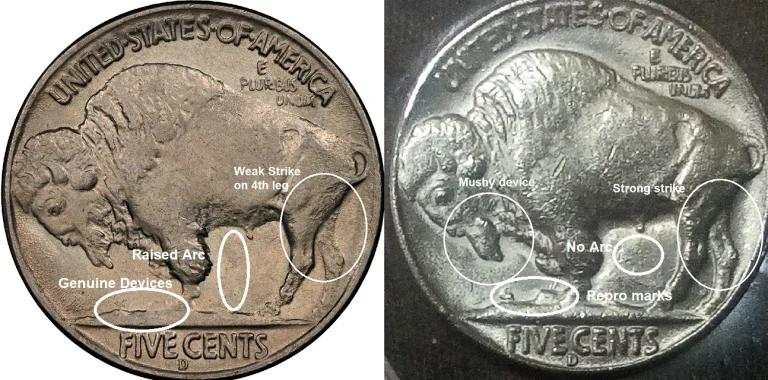
Real vs. fake — the genuine 3-Legged Buffalo (left) shows characteristic die polish lines on the missing leg area, while the counterfeit (right) shows tool marks from an artificially removed leg
Fake (Altered): Scammers take a common 1937-D nickel and polish off the front leg. Because they disrupt the metal, the motto "E PLURIBUS UNUM" on the reverse is often pushed up or distorted enough that the letters P and U touch the bison’s spine.
Genuine: The letters P and U do not touch the buffalo's back.
2. Inspect the Missing Leg Area
Fake (Altered): You will often see evidence of polishing, grinding marks, or unnatural smoothness around the missing leg and the fields below the buffalo's belly. The hooves are usually gone entirely.
Genuine: Authentic error coins were caused by over-polished dies. The front leg is missing, but a faint trace of the leg or fur lines usually remains in the space. Crucially, the hoof is usually still clearly visible hovering above the ground.
3. Look for the "Urinating Buffalo" Line
Genuine: Authentic 1937-D 3-legged nickels often have a distinctive raised arc of metal starting at the hind legs and dropping toward the ground. This natural die flaw resembles a line running from the buffalo's stomach/hind area. If this is missing, the coin might be an altered version of a different die year.
4. Verify the Mint Mark & Date
The rare 3-legged variety only officially happened at the Denver Mint in 1937.
Check for a "D" mint mark below the words "FIVE CENTS" on the reverse. No mint mark or any other year (like 1936 or 1938) means it is definitely not an authentic 3-legged Buffalo nickel.
When in Doubt, Get it Certified
Because these are highly coveted collector's coins that can sell for hundreds or thousands of dollars, raw coins (ungraded) carry a high risk of being altered fakes. Always favor or submit pieces to reputable third-party grading services like, the Certified Acceptance Corporation (CAC), the Professional Coin Grading Service (PCGS), or the Numismatic Guaranty Company (NGC) for authentication.
0 Replies
Related Threads
- Mirror-Clone Grading Websites: The Newest Counterfeit Scam Targeting Coin Collectors0 replies · 3mo ago
- The Rise of Chinese Counterfeit Coins: What Collectors Need to Know About the Scale of the Problem0 replies · 3mo ago
- Counterfeit Coin Slabs Are Getting Dangerously Good — How to Spot Fake PCGS and NGC Holders in 20260 replies · 3mo ago
- How to Read PCGS and NGC Holders — and Spot a Counterfeit Slab0 replies · 3mo ago
- 1804 Dollar and Other "Too Good to Be True" Coins: How to Recognize Replicas0 replies · 3mo ago